Some time ago I splurged on the entirely superfluous purchase of a european fit jumping saddle pad for Highboy. It was much more than I would normally spend on a pad, but it is exactly what I wanted. From the custom colors with three shades of brilliant green piping, to the pockets where I can add shims to make minor adjustments to saddle fit, to the perfect lambskin lining under the saddle and in the front and back, it is a beautiful piece of tack that has made me inordinately happy. I took Highboy for a ride in it and the whole "matchy-matchy-ness" of it made me hearken back to my childhood when I would have given anything to be able to afford something this nice. Adulthood has its perks! Now I can't wait to get out to school cross country with him!
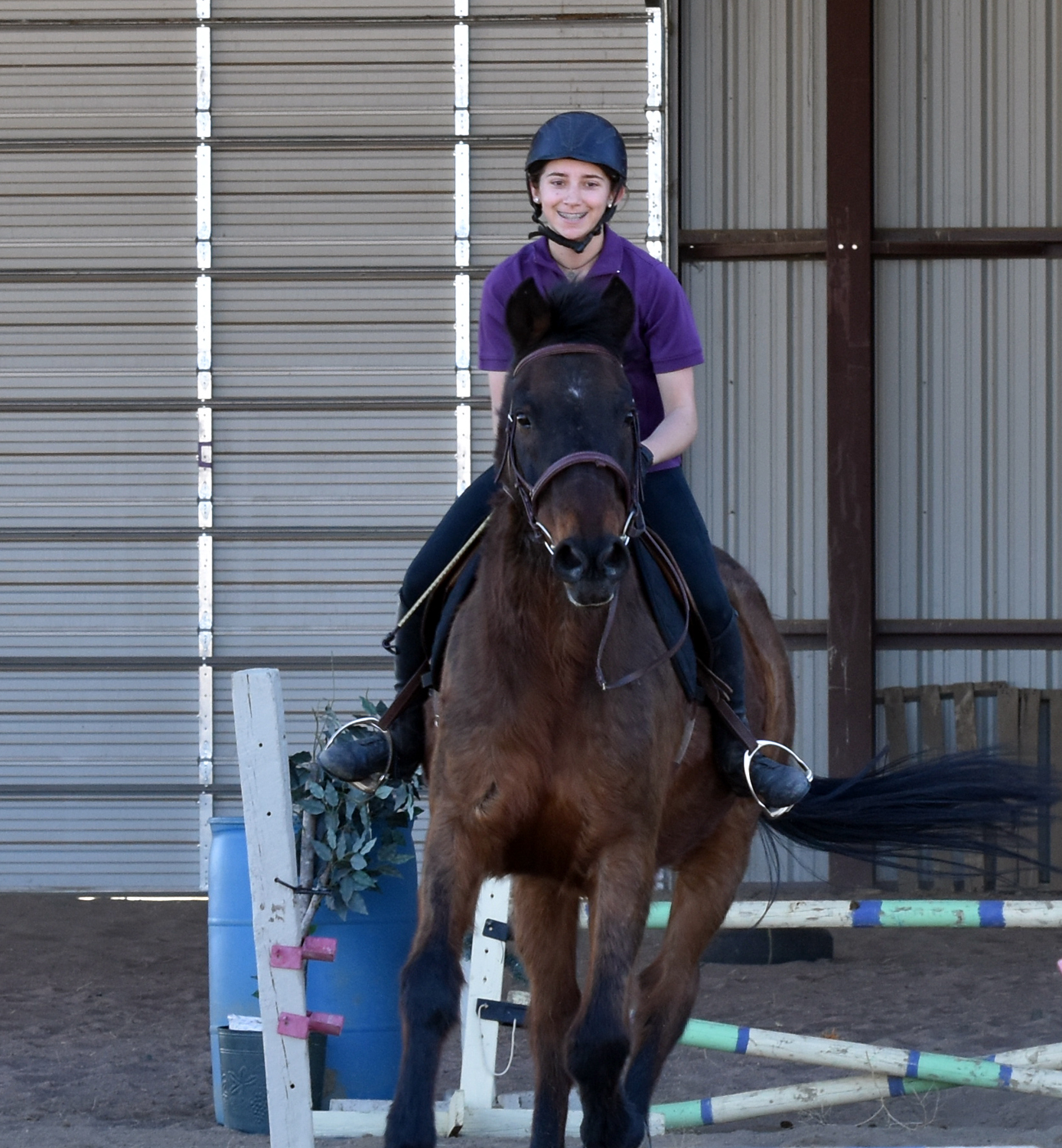
Kim H. also was feeling her "matchy-matchy" with a great teal ensemble. While you can't see it in these photos, there is cute orange trim on her pad which matches the orange stirrups she has, too. Whose to say that grownups can't enjoy the color schemes we would have also enjoyed as teenage girls?
Welcome to Bit of Honey Training LLC
Tuesday, March 7, 2017
Saturday, March 4, 2017
Ride a Draft... It Makes Your Butt Look Small
Tao has such a kind eye, it's no wonder he's so beloved around here.
Tao loves to jump, he always is careful to the fences and takes a good look before smoothly hopping over.
Tao may be a Haflinger pony, but he has a draft horse brain and physique despite his vertically challenged stature. The angle on this one photo was just right with Sara in the background looking tiny to make Tao appear to be a Belgian instead of a Haflinger.
Jasi rode Chester and did a little bit of jumping with him. We're still conditioning him so the jumping exercises are very light, but he sure enjoys it. It's hard to tell who is smiling bigger, Jasi or Chester.
Wednesday, March 1, 2017
Building Blocks
Centered Riding Basic Exercises:
What is your favorite
exercise you use for any one or more of the Centered Riding basics?
This is a hard one, because I have riders who are so
different in their abilities and thought processes, therefore I use a tremendous
variety of exercises for all different issues.
One example is for building blocks, I use the technique of
pulling on the rider’s reins when they are mounted with bodies in alignment and
out of alignment to illustrate that the rider creates pivot points and throws
herself out of balance when her building blocks aren’t stacked correctly.
Explain when you use
the exercise:
I use it after they have warmed up, when I see that they are
struggling with balance front/back and their horse is having difficulty
maintaining a steady rhythm. (often also
a breathing issue) Sometimes if the horse
is a really good sport he’ll compensate for the rider error, in which case I
use the rein-pulling exercise when I see misalignment.
why you use the
exercise
The horse isn’t able to balance the rider (or himself) if
her building blocks are out of alignment, which manifests as all kinds of
problems often blamed on the horse. I
use the exercise if I notice or I hear rider complaints about the horse won’t
go straight, he won’t keep a consistent pace, he won’t use his hind end, he’s
stopping at fences, he falls in on turns, etc.
and how you use the
exercise:
I will have the rider halt the horse and I will ask if I can
place my hands on her center. If she’s
not comfortable with this I hold the reins and I have her place her own hands
on her center. Once she’s centered and if
I have permission to touch her legs I realign the body to get the building
blocks stacked correctly. I sometimes
take a “before” and “after” photo from the side so the rider can review the
difference visually if that’s helpful for her learning style. Two point position will often get the leg in
the correct place as well because the rider can’t stay up in a two point if the
leg isn’t underneath her. I have the
student “take it for a walk” and ride the horse around in this new position to
make mental notes of how the horse has changed and how the rider's body feels. Once we discuss how the new position feels I
have her switch back and forth between the old position and the new position to
give her practice correcting it herself without me micromanaging.
![]() |
| Notice the plumb line goes through shoulder and hip, but not ear or heel |
I explain that this new way is a balanced position, and it’s
correct for dressage, western dressage, western equitation, and it looks
good. I explain that this is the
position that wins, but that’s not why I have my students do it.
I then have the student go back to sitting in their old
position, I stand in front of the horse, and I tell the rider to stay in the
saddle while I pull on her arms via the reins.
Mostly they teeter right out of the tack as they brace on stirrups or
knees and lock lower back and elbows. I
then have them re-center, realign building blocks getting into the new position,
and I tell them to take a deep breath while I pull on the reins from the front
again.
![]() |
| Notice the plumb line goes through shoulder, hip, heel, and only misses the rider's ear |
The rider is usually amazed that it takes nearly no effort to stay
put in this new position when I tug on the reins. I then explain
that while it’s a prettier position, this STABILITY is why I want my students
to ride this way. They are SAFER. No matter what happens on the trail, if a pigeon dive bombs them in the arena, or their horse spooks at who knows what,
when they are in this position, GRAVITY holds them in the tack, not their
muscles. This makes it a much safer way
to ride, and as an added bonus it looks good, too.
These last two photos show the importance of saddle fit (particularly for the rider) affects building blocks and a plumb line. Notice how in the photo with a poorly fitting saddle the rider's leg is WAY in front of the plumb line, and in the good fitting saddle photo the plumb line is very close to ideal.
Tuesday, February 28, 2017
Interview for the Thoroughbred Makeover
I was recently asked to do an interview regarding my experiences with Note and the Retired Racehorse Project Thoroughbred Makeover. Here are my responses
Your
Name: Kim
Leonard
Horse’s
Name: One for Nothing (“Note”)
How
long have you been riding? What’s your discipline now? What appeals to you
about your chosen sport? I’ve been riding for 30 years, working as a full time horse trainer,
certified riding instructor, and business owner at Bit of Honey Training LLC
since 2007. My riding instructor
certification is through Centered Riding, which I explain as a
nondenominational style because it works for every discipline. Regardless of what type of saddle you use or
breed of horse you ride, Centered Riding is useful and applicable because it
helps you to change your own body to better influence your horse.
My personal sport of choice is eventing,
because training for all three phases allows me the greatest variety of experiences
for the horse. Combining the balance of
dressage, the footwork of show jumping, and the conditioning for cross country creates
an incredibly well rounded horse (and rider!).
How
did your horse do at the track? How did you find them?
One For Nothing was a six year old cryptorchid
stallion who raced 44 times, nearly once a month through his racing days.
Over the course of his career he won more than $40,000, coming in first four
times. He retired sound, and I found him through my connections at CANTER
Arizona in the trainer listings.
What
do you like about TBs generally? Do you think of yourself as a TB person?
I am definitely a Thoroughbred person. These horses have the ideal combination of
traits which I look for in a horse:
athleticism, heart, personality, and sensitivity. I particularly enjoy OTTBs because they come
with so much life experience already having been exposed to so many situations
and various environments throughout their racing careers.
What
attracted you to the RRP?
I have always been a Thoroughbred fan, a
love affair with the breed which began in my childhood when I had the
opportunity to restart a dark bay mare called Fourth of July for a paint
breeding farm where I worked in New England.
Now that I live in Colorado and since we have a track here in Denver I am
fortunate to have access to great athletes coming off the track when they are
done racing. I discovered the RRP online
when it began and had its first show at Pimlico, and I have followed it ever
since.
Have
you worked with RRP before?
I have assisted with the RRP’s presence at
the Rocky Mountain Horse Expo here in Denver, Colorado for the past three
years. As a trainer for CANTER Colorado
I took CANTER owned Sweetpeacefuldream to the 2015 RRP Thoroughbred Makeover
and competed in showjumping. It was a
wonderful experience, and possibly the first time a Colorado bred and raced
Thoroughbred had competed at the Kentucky Horse Park.
Have
you decided what you are doing at RRP? If you have what are you doing/planning?
If not – why not? What will help you make up your mind?
I am currently planning to compete with One
For Nothing in eventing and competitive trail.
This is of course dependent on Note’s aptitudes and interests. If he were to decide he hates jumping we
would train for dressage instead, and if he decides he likes cattle we would
get him to my neighbors’ place so I could start ranch work with him. I have my own interests with riding, but my
ultimate goal is to create a happy sound horse who enjoys his job of choice.
What
are you looking forward to about RRP?
The experience of having a horse at the
Kentucky Horse Park competing is incredible, especially considering the
distance we need to travel to get there from Colorado. The show grounds are historic, the photo
opportunities are abundant, and there is nothing quite like a competition full
of retired racehorses succeeding in ten different disciplines. The camaraderie among trainers is great fun,
and to gather a group of this caliber horses speaks volumes about what the
breed has to offer the sport horse world.
What
challenges do you already see?
As for my individual horse, Note required a
long recovery from a very involved abdominal cryptorchid gelding surgery. Once physically healed it was a little tricky
to determine the right feed for his physical and psychological needs.
There are the usual challenges with an individual horse of how best to communicate with him in his training program. A racehorse like Note who loved his job running and was very dedicated to it can be challenging to transition to a slower-paced second career. I’ve been fortunate to have worked with many OTTBs and have an extensive knowledge base involving the combination of good veterinary care including dental work and ulcer treatment/prevention, quality farrier attention, nutritional analysis, tack evaluation, and social needs. All these factors play into creating a happy sound horse in his second career.
Does
your RRP horse live with you or is it boarded?
Note lives at Bit of Honey Training LLC, my
training facility where I also live.
What
accomplishment (horse or not) are you most proud of?
The accomplishment of which I am most proud
is my recovery from a traumatic brain injury.
In 2008 a quiet, well-trained horse I was riding slipped and fell and I
was knocked unconscious. I spent
significant time in a wheelchair and then with a walker, and it was a
Thoroughbred named Cecil who eventually got me back in the saddle. Upon initially meeting me today, most people don’t realize
I have had brain damage. While I still
have significant limitations, and need to compensate for the brain damage I
sustained, I am fortunate to be able to ride, teach, and train these amazing
horses despite having a handicap not easily visible to the public eye.
What
is your most treasured horse possession?
I
have a collection of the halter nameplates from all my horses who have passed
on. I reuse the leather halters, but the
brass nameplates hang on the wall in my office.
What’s
your training plan for March and April?
March and April will be filled with long
trail rides in the mountains here in Colorado.
Note is a thinker, and needs more stimulation than circles in the arena
can give him, so 20+ mile rides in open space will be just the right thing for
him. He will still work some in the
arena and over fences, but we will be revisiting the endurance days of my youth
to condition him for the cross country phase of eventing as well as prepare him
for competitive trail riding.
Subscribe to:
Posts (Atom)