Welcome to Bit of Honey Training LLC
Monday, January 27, 2020
Problem Solving - Bucking
I often tell people: I can ride bucking, and I can ride spinning, but I'm terrible at riding them both at the same time.
Today I was able to get on most of the horses, and Ferriana was my last ride of the day. She warmed up well, it's satisfying to see her balance improving every time we ride. She was wearing the dressage saddle which we hadn't worked in for a couple weeks, but it still fit nicely. I check tack and equipment really regularly because it's so important that the horse is able to comfortably do the athletic things I ask of them, and also because I have several horses who turn into broncs if the equipment isn't fitting correctly.
We worked on circles, turns, and switching from traveling straight to on a curve in both directions. For canter work we first picked up the right lead (her easier lead), then the left. We took a little walk break and gave some cookies to Rizzo the dog who was helping with the ride. Then I picked up the trot again and Ferriana resumed her rhythmic gait.
When I asked for a left lead canter again she picked it up fairly easily, but kept losing her balance in the corners of the indoor arena. To help with this I added a little inside leg and stabilized her by grounding my outside foot and supporting with my outside rein. Each time she'd lose her balance I'd get a HUGE buck, like heels over her head airs above ground. I began thinking through all kinds of possibilities, trying to figure out why she didn't do it earlier in the ride. Was she getting tired? Was Rizzo running too closely and causing the bucking in play? Was the saddle not fitting as well as I thought? Was she sore? Was my body fatigue and the soreness I could feel coming after a long day of riding affecting her?
We tried several times to hold that left lead canter through the corner with the same results - a giant buck whenever I tried to help stabilize her. I then tried a right lead canter, which was somewhat better, but still when I tried to help her balance she'd launch her hind feet into the air. At one point she bucked hard enough that while I remained seated (see my disclaimer that I'm pretty good at riding bucking as long as there's no spinning), my cell phone was tossed right out of my pocket and landed in the sand.
At this point I decided something was wrong and I wasn't going to figure it out from the saddle. Before I got off I trotted Ferriana a few times each direction asking her to really stretch and loosen up, which she did. This made sure she didn't associate my dismounting with the bucking (it would only take one incident and this mare would very quickly realize that bucking was very effective in getting rid of riders). It also allowed me to rule out some types of pain, since she wasn't bucking at the trot and was comfortable.
Once I was on the ground again I put her on the lunge line to have her canter each direction without a rider. I wanted to see what she did in the same situation, just without me aboard. She did this quite nicely, taking each lead easily and successfully cantering a twenty meter circle both to the left and the right. There was no bucking, no playing with Rizzo, it was generally very civilized. I took a deep breath to stop her and have her come in the middle of the arena with me, which she did happily. Ferriana nuzzled my hand, and when I tilted my head to tell her she was a good girl I caught a glance at my left boot. The zipper that runs along the back of the boot had worked its way halfway down my calf, and the zipper pull was sticking straight out away from my leg.
That explained everything. Each time Ferriana lost her balance, I'd add a little left leg to help her shift her weight back to her right hind. Normally this works great, but with the zipper coming undone and the pull sticking straight out, essentially I was spurring her with my calf by poking her with the zipper! Of course she bucked - she rightly was trying to tell me there was no need to spur her, she understood just fine what to do!
I'm grateful it wasn't a more involved process to determine the issue. It could have been saddle fit, the dog, attitude, lameness, cold moving in... anything, really. It would have been very easy to blame the bucking on bad attitude or naughtiness, and if I'd done that I would have completely missed what Ferriana was justly trying to tell me. Thankfully all I need to do is be more vigilant about the zippers on those boots and the problem is solved.
Sunday, January 19, 2020
Tack Room Reorganized
For a couple years I've had an eye out for tack lockers, but it's hard to find them in the size I wanted for less than $1000 each. It seems like my tack room very quickly becomes a storage facility for clients when there aren't clear boundaries for how much space a person can take in the barn. Additionally, I wanted lockers for the clients so we didn't have to worry about dust and cats getting into their stuff. Mice aren't an issue since I have such good working cats, but occasionally they are overzealous in their tack room adventures and equipment gets scratched.
In my internet searches I finally came across the "Slim Jim Cabinet" rubbermaid lockers at an office supply company called Uline. They weren't too expensive (though shipping from TX was!) and so I bought a bunch.
On several of our nasty windy days I assembled and installed the lockers in the client side of the tack room, with the saddle racks going clear through the cabinet to anchor into the wall behind them. Rizzo and Pascal the dogs helped by keeping me company and moral support, and Pascal made sure to assist by touring the inside of each locker as I installed bridle and saddle racks. He did attempt to take my drill a few times, with a quick nod in my direction as if to say, "I"ll be right back, Kim, I just need to drill this real quick".
It was awfully cold on some of those windy days, so I gave Rizzo an old holey horse blanket to snuggle in that was just about ready to be thrown away. She also has her own carharrts jacket that she wears on cold days. She and Pascal have such similar color, and now that they are about the same size it can be a challenge to differentiate which body part belongs to whom in some of the photos!
Here is the "before" photo of the tack room, when I'd dumped everything on one side so I had room to assemble and install the lockers. It sort of looks like Dover exploded.
And here is the "after", with lockers assembled, installed, and blankets hung. The feed area also got reorganized, so there's actually space to get in and out! Now each boarder has a locker, and they are welcome to store anything that fits in the locker. If it doesn't fit, it goes home. Each locker easily holds two saddles, two bridles, two saddle pads, a grooming tote, helmet, and boots for each horse.
In my internet searches I finally came across the "Slim Jim Cabinet" rubbermaid lockers at an office supply company called Uline. They weren't too expensive (though shipping from TX was!) and so I bought a bunch.
On several of our nasty windy days I assembled and installed the lockers in the client side of the tack room, with the saddle racks going clear through the cabinet to anchor into the wall behind them. Rizzo and Pascal the dogs helped by keeping me company and moral support, and Pascal made sure to assist by touring the inside of each locker as I installed bridle and saddle racks. He did attempt to take my drill a few times, with a quick nod in my direction as if to say, "I"ll be right back, Kim, I just need to drill this real quick".
It was awfully cold on some of those windy days, so I gave Rizzo an old holey horse blanket to snuggle in that was just about ready to be thrown away. She also has her own carharrts jacket that she wears on cold days. She and Pascal have such similar color, and now that they are about the same size it can be a challenge to differentiate which body part belongs to whom in some of the photos!
Here is the "before" photo of the tack room, when I'd dumped everything on one side so I had room to assemble and install the lockers. It sort of looks like Dover exploded.
And here is the "after", with lockers assembled, installed, and blankets hung. The feed area also got reorganized, so there's actually space to get in and out! Now each boarder has a locker, and they are welcome to store anything that fits in the locker. If it doesn't fit, it goes home. Each locker easily holds two saddles, two bridles, two saddle pads, a grooming tote, helmet, and boots for each horse.
Riding Schools
Winter is that tough time of year when the wind often deflates all hopes of riding. I can do cold, I can do snow, but wind is a totally different beast. Over the past couple weeks we've been able to sneak rides in here and there, and despite irregular riding schedules I'm pleased with how the horses and riders are doing!
I've set up some tricky coursework in the arena, involving lots of turns both in the air over fences as well as on the flat. I call this one the cloverleaf, since we ride that shape as we go over the jumps. Silver and Gillian have gotten quite good at it, even getting accurate lines to the fences and correct leads after landing.
Carol and Ladd have been doing well, too. Since they haul in for lessons they haven't had a chance to do as much of this exercise, but figuring out the turns and lines is the same skill whether you're doing it fast over big jumps or slowly over small ones.
Joan and Sam are getting along so well, and he has really improved her riding. He's a very different type of horse than what she was accustomed to riding before she bought him, but we can't ask for a better mind than Sam's! He also takes incredibly good care of Joan over fences.
Kim H and her mare, Rain, started work on this exercise this weekend too.
Raven loves her job, and so I switch it up for her when she needs to be challenged a little more. We do the course faster, over slightly larger jumps. and add in some additional fences. Last week I was able to snag some gigantic nutcracker soldiers at a craft store on clearance after the holiday, and since they are for indoor/outdoor use I set them up in the arena as jump decor!
Sara has been using Shambhu in a couple riding lessons and that is going really well. It's nice to ride a different horse occasionally so that you can realize that you do have the skills and techniques needed to accomplish the task, and to fine tune your own horsemanship. Then when you've been able to feel with your body how things are supposed to be, you're able to go back and recreate that sensation with your own horse. There are lots of perks to riding a schoolmaster!
Ferriana is coming along nicely, and despite us doing a lot of long walks and hacking out in the fields, whenever we resume arena work it's like no time has passed. She's smart enough to remember everything and pick up right where we left off.
I've set up some tricky coursework in the arena, involving lots of turns both in the air over fences as well as on the flat. I call this one the cloverleaf, since we ride that shape as we go over the jumps. Silver and Gillian have gotten quite good at it, even getting accurate lines to the fences and correct leads after landing.
Carol and Ladd have been doing well, too. Since they haul in for lessons they haven't had a chance to do as much of this exercise, but figuring out the turns and lines is the same skill whether you're doing it fast over big jumps or slowly over small ones.
Joan and Sam are getting along so well, and he has really improved her riding. He's a very different type of horse than what she was accustomed to riding before she bought him, but we can't ask for a better mind than Sam's! He also takes incredibly good care of Joan over fences.
Kim H and her mare, Rain, started work on this exercise this weekend too.
Raven loves her job, and so I switch it up for her when she needs to be challenged a little more. We do the course faster, over slightly larger jumps. and add in some additional fences. Last week I was able to snag some gigantic nutcracker soldiers at a craft store on clearance after the holiday, and since they are for indoor/outdoor use I set them up in the arena as jump decor!
Sara has been using Shambhu in a couple riding lessons and that is going really well. It's nice to ride a different horse occasionally so that you can realize that you do have the skills and techniques needed to accomplish the task, and to fine tune your own horsemanship. Then when you've been able to feel with your body how things are supposed to be, you're able to go back and recreate that sensation with your own horse. There are lots of perks to riding a schoolmaster!
Ferriana is coming along nicely, and despite us doing a lot of long walks and hacking out in the fields, whenever we resume arena work it's like no time has passed. She's smart enough to remember everything and pick up right where we left off.
Saturday, January 4, 2020
Coyote Ridge and Rim Rock Trails
Shambhu, Carol, Raven, and I all went for a "town ride" in Fort Collins this morning. We wanted to hit the trails since we were feeling a little stir crazy, however many of our favorite places were closed because of wet and icy trail conditions. So we headed to the Southwest section of Fort Collins to Coyote Ridge trail head. I'd been hiking there ages ago when I was in college, but had never gone with horses.
I figured we would have plenty of company since this is a heavily trafficked trail in town, and I was right. Before we had even mounted the horses, a bus pulled up and unloaded approximately twenty elementary school age kids. They were all dressed identically in matching black jackets with white stripes, and something about the uniformity of their presentation freaked out poor Shambhu. He didn't do anything naughty, but he sure froze and stared at them with great angst.
We then started out our ride on the even and flat groomed trail near the parking lot. Right off a cyclist came barrelling towards us as fast as he could pedal. I don't know if he had earbuds in or what, but he never seemed to hear Carol and I shouting or see us waving to have him slow down, and when he finally looked up from the smooth path immediately in front of him he was within twenty feet of us. He then grabbed his brakes hard and squealed the bike sideways towards us, spooking Raven who is relatively new to bicycles. She leaped into the air and shot sideways, and the cyclist resumed pedaling madly to speed past us. I don't know what happened to this guy's manners, but they were sorely lacking this morning! There were signs all over the trails stating that both hikers and cyclists yield to horses.
After that initial drama mostly everyone else on the trail was wonderful. Hikers, cyclists, runners, and little kids all stepped off the trail to let us pass or to let Raven check out the bikes. They talked to us which helped the horses realize they were people, not monsters. The first group of hikers that stopped were making small talk, and Raven sauntered right over to the woman, put her nose near her face, and asked for a cookie! I quickly corrected her, and thanked the woman for her patience as I explained Raven is new to trail traffic and was asking if she had anything tasty to share. Fortunately the woman laughed and wasn't bothered by Raven's indiscretion.
Most of the six mile ride was good footing, however there was one section of trail that stayed shaded all day due to hills, and that part was icy. Raven has become my "go to" horse, and that's partly because she's so sure-footed even in difficult terrain. She carefully and confidently made her way up the hill, never putting a foot wrong even when her hoof would break through the crust of snow. The only other technical aspect was a very rocky segment near the top, but I think I've got one of the only Thoroughbreds with excellent feet and Raven just marched up with near disregard for the rocks and stones.
Once we were near the top and the viewpoint we spotted the large group of kids who had previously disembarked from the bus in the parking area. Carol and I took Shambhu and Raven just off the trail so they could watch the herd of kids as they came down. There were about four adults with the group, and they had several kids with each of them so they came down in small clumps. The adults who had the kids with them made them walk so as not to scare the horses, but there was the occasional kid who took off running from a back group to join a front group who had selective hearing and neglected to walk as they'd been told.
Fortunately Raven has seen lots of kids, noisy dogs, and other small quick moving creatures so she wasn't too concerned. One little boy, probably about eight years old, did slow to a walk, crouched down, and slunk towards Raven with his hands out in front of him like he was going to grab her. Raven merely stood there and looked at him with disdain. When she didn't react he then jumped towards her and clapped his hands to see if he could get a reaction. Raven didn't really respond, but I sure did.... I was pretty loud and clear declaring that wasn't appropriate and it might scare a horse. (Which was probably his plan to begin with). He mostly ignored me and continued down the trail. All the other kids were pretty good, and we made sure to thank them and the leaders for walking towards us.
Once we turned around and headed back towards the trailer Raven was ready to kick into another gear. She did behave, however, and even slowed down when I asked so we could wait for Shambhu, who is careful but less confident going downhill on ice with a drop-off on one side.
Back at the trailer we untacked, liberally dispensed cookies to the good ponies, and headed home. It was so great to be off the ranch and on the trail, and as a bonus Raven was totally fine with bikes and was ignoring pedestrians by the end of the ride.
I figured we would have plenty of company since this is a heavily trafficked trail in town, and I was right. Before we had even mounted the horses, a bus pulled up and unloaded approximately twenty elementary school age kids. They were all dressed identically in matching black jackets with white stripes, and something about the uniformity of their presentation freaked out poor Shambhu. He didn't do anything naughty, but he sure froze and stared at them with great angst.
We then started out our ride on the even and flat groomed trail near the parking lot. Right off a cyclist came barrelling towards us as fast as he could pedal. I don't know if he had earbuds in or what, but he never seemed to hear Carol and I shouting or see us waving to have him slow down, and when he finally looked up from the smooth path immediately in front of him he was within twenty feet of us. He then grabbed his brakes hard and squealed the bike sideways towards us, spooking Raven who is relatively new to bicycles. She leaped into the air and shot sideways, and the cyclist resumed pedaling madly to speed past us. I don't know what happened to this guy's manners, but they were sorely lacking this morning! There were signs all over the trails stating that both hikers and cyclists yield to horses.
After that initial drama mostly everyone else on the trail was wonderful. Hikers, cyclists, runners, and little kids all stepped off the trail to let us pass or to let Raven check out the bikes. They talked to us which helped the horses realize they were people, not monsters. The first group of hikers that stopped were making small talk, and Raven sauntered right over to the woman, put her nose near her face, and asked for a cookie! I quickly corrected her, and thanked the woman for her patience as I explained Raven is new to trail traffic and was asking if she had anything tasty to share. Fortunately the woman laughed and wasn't bothered by Raven's indiscretion.
Most of the six mile ride was good footing, however there was one section of trail that stayed shaded all day due to hills, and that part was icy. Raven has become my "go to" horse, and that's partly because she's so sure-footed even in difficult terrain. She carefully and confidently made her way up the hill, never putting a foot wrong even when her hoof would break through the crust of snow. The only other technical aspect was a very rocky segment near the top, but I think I've got one of the only Thoroughbreds with excellent feet and Raven just marched up with near disregard for the rocks and stones.
Once we were near the top and the viewpoint we spotted the large group of kids who had previously disembarked from the bus in the parking area. Carol and I took Shambhu and Raven just off the trail so they could watch the herd of kids as they came down. There were about four adults with the group, and they had several kids with each of them so they came down in small clumps. The adults who had the kids with them made them walk so as not to scare the horses, but there was the occasional kid who took off running from a back group to join a front group who had selective hearing and neglected to walk as they'd been told.
Fortunately Raven has seen lots of kids, noisy dogs, and other small quick moving creatures so she wasn't too concerned. One little boy, probably about eight years old, did slow to a walk, crouched down, and slunk towards Raven with his hands out in front of him like he was going to grab her. Raven merely stood there and looked at him with disdain. When she didn't react he then jumped towards her and clapped his hands to see if he could get a reaction. Raven didn't really respond, but I sure did.... I was pretty loud and clear declaring that wasn't appropriate and it might scare a horse. (Which was probably his plan to begin with). He mostly ignored me and continued down the trail. All the other kids were pretty good, and we made sure to thank them and the leaders for walking towards us.
Once we turned around and headed back towards the trailer Raven was ready to kick into another gear. She did behave, however, and even slowed down when I asked so we could wait for Shambhu, who is careful but less confident going downhill on ice with a drop-off on one side.
Back at the trailer we untacked, liberally dispensed cookies to the good ponies, and headed home. It was so great to be off the ranch and on the trail, and as a bonus Raven was totally fine with bikes and was ignoring pedestrians by the end of the ride.
Sunday, December 15, 2019
Training the Horse Training Dog
We've been having some issues with Rizzo as she adjusts to living here and becomes more confident. When she first arrived she decided I was her person, which was fine, and she stuck close to me all the time. She even would get anxious when she couldn't get to me, and became really vocal if someone other than me had her on a leash. The separation anxiety was both a blessing and a curse!
Rizzo also had not been properly crate trained by her previous two adopters (yes, she was returned twice to the rescue). It appears that they would stuff her in a crate when they were leaving, but never really taught her that it was her safe place, a private bedroom, and her refuge when she needed some "me" time. By the time I got her she was extremely anxious when confined in a crate, even destroying a wire one, shredding any bedding I would put in her plastic one, and making terrible torturous noises at an ear splitting pitch. This would go on for hours, and while Miles could get her to be quiet, once Miles was gone she had no one to give her rules and structure when alone in the crate.
We combated the noise by letting her hang out loose in the heated garage at night, and she was fine with that. She had a fluffy dog bed made from my old barn jeans on a bench that she snuggled into each evening, and she seemed quite content with that setup. However, being loose and being such a bouncy dog, she would also hop up onto the cars in the garage when they were parked there. We didn't want scratches on the cars, but we didn't want her screaming, either.
I did some brainstorming and recognized that Rizzo seemed to feel safest when she was up high. She has many cat-like behaviors and traits, and this is one of them.
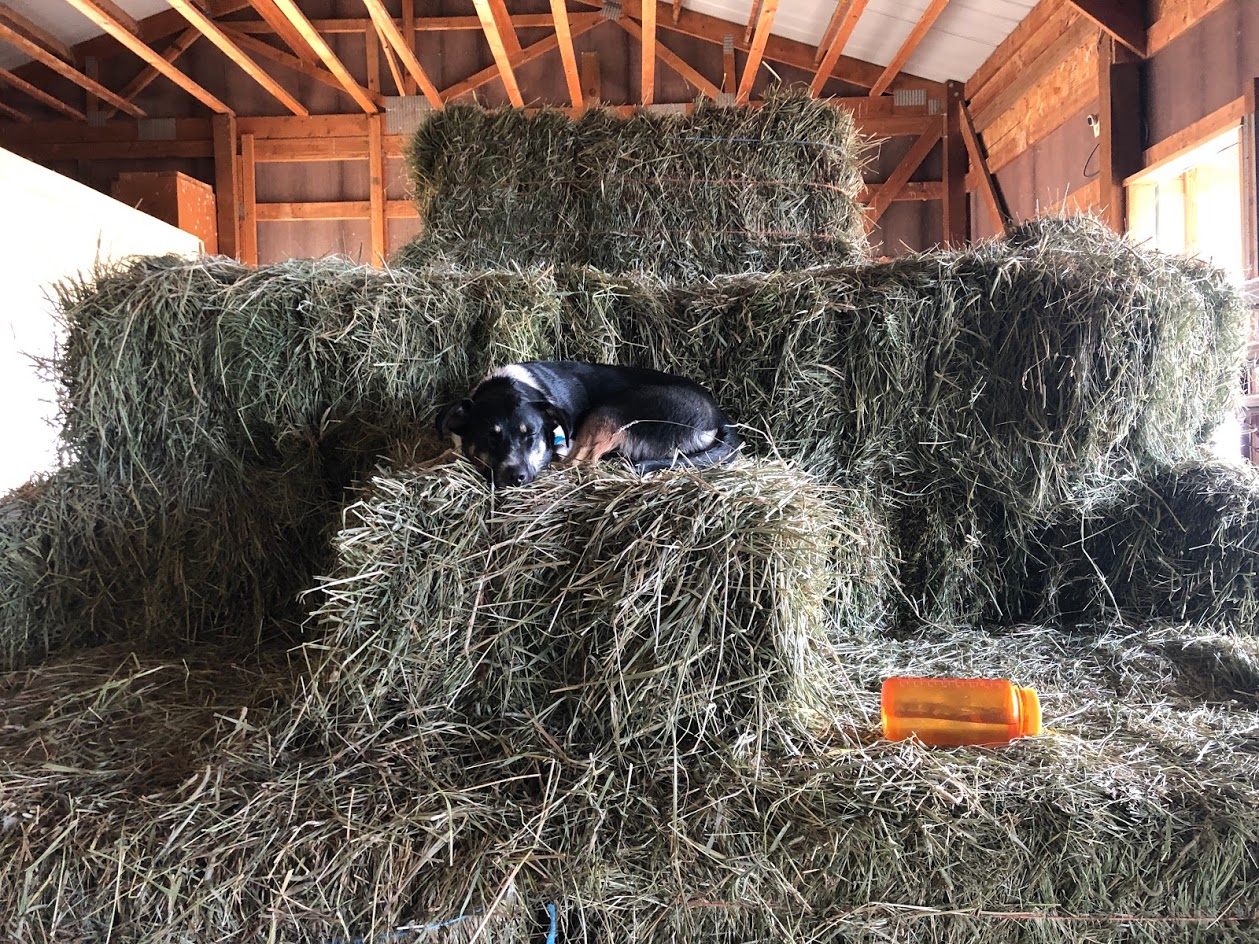
While we're in the barn, her preference is to nap on the top of the hay stack while I'm tacking up horses, and she often can be found hanging out on the top of the big round bales stored outside.
Rizzo recently taught Pascal how to climb to the top of the bales as well, and now the two of them enjoy romping around at heights hitherto uncharted for dogs of this small stature!
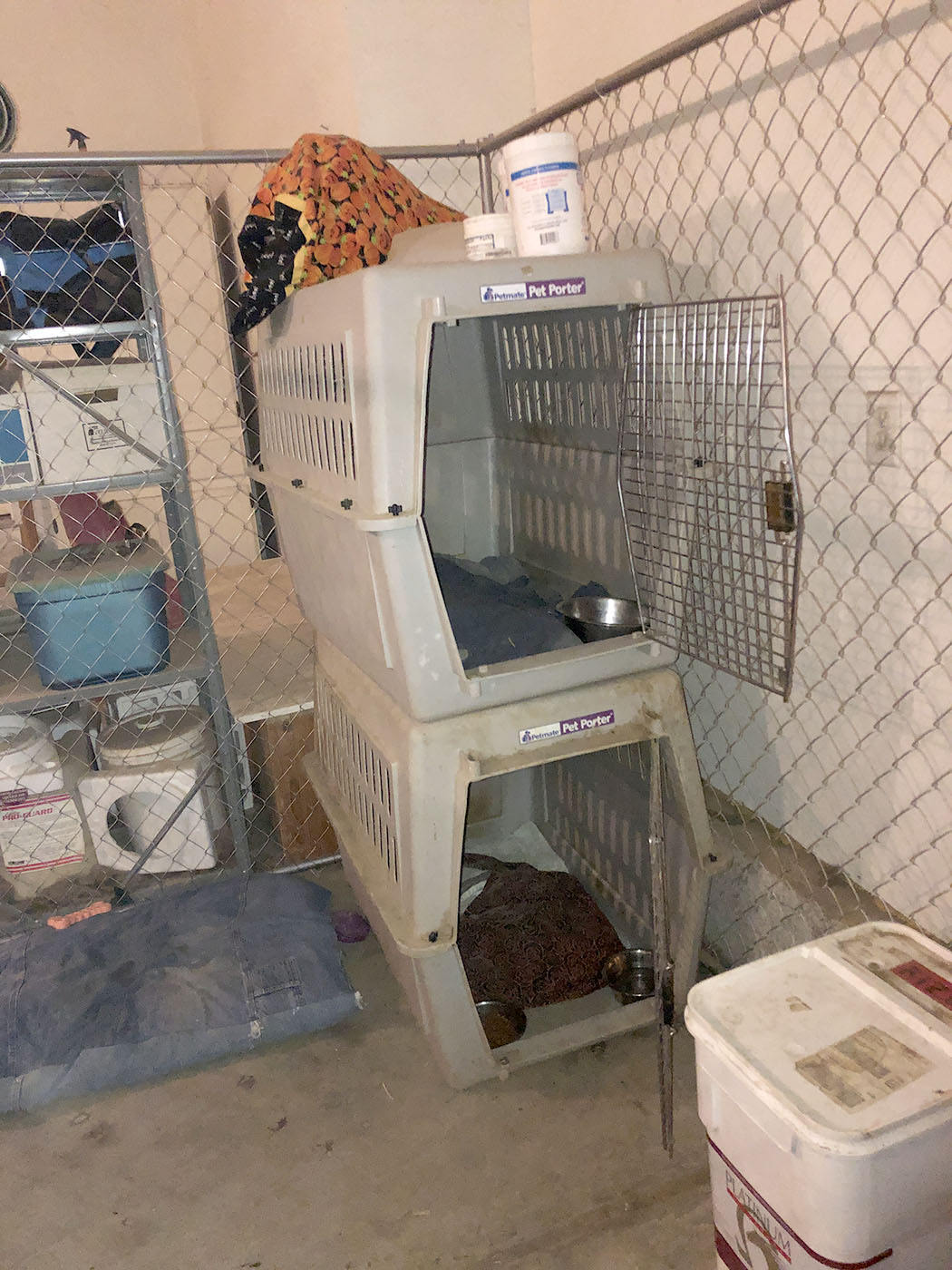
To tap into this love of heights, I decided to stack the dog crates on top of one another. Perhaps part of Rizzo's anxiety at being confined in the crate was that being so low to the ground she didn't feel safe with no escape from potential or imaginary threats at ground level? To make the height and new location extra fun, I positioned the dog food tub in a way that she can hop up on it and then into her crate, since she really loves jumping around at heights. Perhaps she was a skydiver in a past life.
I also took her favorite dog bed from the bench (seen here just outside the kennel behind the crates) and placed it in her crate. Putting her bed there created an association of safety and comfort in the crate, which also felt safer since it was now up high, and all her meals and treats are given to her in the back of the lifted crate. How could she resist a kong toy filled with peanut butter and kibble, placed on her favorite bed, lifted up to a safe height, and with an open door so she can come and go as she pleases? It additionally gives her a spot to escape Pascal's constant poking and requests to play.
After wiring the kennel in such a way that the mesh can't be pulled away from the bottom of the frame, I placed all the tasty treats in their designated locations, put both dogs in the kennel, and voila'! Rizzo now likes her crate and will happily go in to eat dinner, escape Pascal, and there is no stressful vocalization.
Our next issue as Rizzo gains confidence is that she has begun wandering. When Miles was here he made it clear that she was to remain in the barn or with me, that was her job. Now that Miles is gone, and Pascal has arrived as a partner in crime, Rizzo has gotten bolder. Unfortunately they are too close in age to really have the mentor/protege' relationship, and the dynamic has become one of two puppies acting as stupid kids having fun rather than focusing on the task at hand. The reason I have these dogs is to help me train the horses, and if they are running around at the neighbors' properties they're not helping.
When I was working at vet clinics we would always caution people against getting two pups from the same litter, precisely because of this issue. They tend to bond to each other and do things together instead of with the human. I'd hoped that Rizzo and Pascal were far apart enough in age to avoid it, but no luck. As a result, they each have gone into individual training with me. Once each dog is extremely reliable on their own with commands and responsibilities I'll return to training them together, but in the meantime each dog has a day (or half day) with me while the other hangs out in the kennel.
So far this is working really well. During Pascal's training sessions he sticks close by me, or hangs out in the barn waiting for me to return with a horse. He likes all sorts of training treats, so watches me closely and tries all kinds of good dog behaviors to earn attention and goodies. Sit, down, c'mere, this way, watch it, up, leave it, are all commands he seems to have figured out and consistently responds to. The only difficulty with him is that it's hard to get things accomplished when I'm continually interrupted for puppy snuggles.
Rizzo also is making good progress, though she's returned to on-leash training for the time being. When doing barn chores she is tethered to me by attaching her leash to my belt, or when I'm handling a horse and the leash is a safety hazard she is tied out of the way to the wall of the barn, arena, or stall. I've also gotten my remote training collar back from being repaired so we have begun aversion training regarding the cats, the road, and the property line. It's a very effective training tool when used correctly as negative reinforcement in conjunction with positive reinforcement, though it can be disastrous if used incorrectly. Getting the timing just right can be tricky, so I don't recommend these collars to people unless they have been properly trained by a professional on how to use it. That includes introducing it to the dog with assessing the proper stimulation level for that individual animal, and correctly applying the training progression.
The gist of the remote collar training process is that I have Rizzo on a 30' line so she can wander around and make her own choices. If she goes near the fence line on the edge of the property I call her back, then give her a treat (so far the favorite is a small taste of American cheese). If she doesn't come right away I can reel her in with the line. If she is ignoring me because she's overly distracted and aiming to go through the fence, I use my remote and hit the button that causes the collar to vibrate at her throat. She is such a smart and sensitive dog that this acts as plenty of stimulation to cause her to avoid the fence (or cat, or road) and return to me, her safe person, for a treat. We have been on several long walks, and after receiving a vibration at the fence when her nose crossed the line, or when she lifted a paw to cross it, she has definitely decided it's safer and better to stay well within our side of the line.
This has worked well for teaching her to avoid the cats, too. A couple brief sessions during which she got a vibration when she darted towards the cats has helped her realize that it's much better to come to me and have some cheese when she's tempted by a cat, rather than press forwards toward them and become uncomfortable.
There are many additional settings on the collar, but I almost never use anything other than the vibration. Especially on a sensitive dog like Rizzo it would do so much more harm than good to use the stronger settings, and it would completely derail the positive associations she has with me and working outside. An intelligent dog will also figure out that there is one set of rules while wearing the collar and that those rules may not apply without the collar, so it's extremely important to use this training tool consistently and in a way that the dog never connects the vibration to the collar, but only believes the fence/cat/road is causing the discomfort. That's why it's much better to learn to use one of these collars from a professional in lessons rather than think the collar itself is a "fix all". It's only as effective as the trainer using it.
Gradually Rizzo will return to off leash work as she resumes sticking with me reliably, and eventually both she and Pascal will be working together off leash. This is a process, however, and the most important piece is keeping both dogs confident, enjoying their work, and looking to me for instruction rather than each other for entertainment. I do love these dogs, and I know the amazing potential they have to be excellent horse-training dogs. That's why it's critical that I train them correctly so that they become reliable and helpful, and thankfully during winter months I have the chance to do it!
Rizzo also had not been properly crate trained by her previous two adopters (yes, she was returned twice to the rescue). It appears that they would stuff her in a crate when they were leaving, but never really taught her that it was her safe place, a private bedroom, and her refuge when she needed some "me" time. By the time I got her she was extremely anxious when confined in a crate, even destroying a wire one, shredding any bedding I would put in her plastic one, and making terrible torturous noises at an ear splitting pitch. This would go on for hours, and while Miles could get her to be quiet, once Miles was gone she had no one to give her rules and structure when alone in the crate.
We combated the noise by letting her hang out loose in the heated garage at night, and she was fine with that. She had a fluffy dog bed made from my old barn jeans on a bench that she snuggled into each evening, and she seemed quite content with that setup. However, being loose and being such a bouncy dog, she would also hop up onto the cars in the garage when they were parked there. We didn't want scratches on the cars, but we didn't want her screaming, either.
I did some brainstorming and recognized that Rizzo seemed to feel safest when she was up high. She has many cat-like behaviors and traits, and this is one of them.
While we're in the barn, her preference is to nap on the top of the hay stack while I'm tacking up horses, and she often can be found hanging out on the top of the big round bales stored outside.
Rizzo recently taught Pascal how to climb to the top of the bales as well, and now the two of them enjoy romping around at heights hitherto uncharted for dogs of this small stature!
To tap into this love of heights, I decided to stack the dog crates on top of one another. Perhaps part of Rizzo's anxiety at being confined in the crate was that being so low to the ground she didn't feel safe with no escape from potential or imaginary threats at ground level? To make the height and new location extra fun, I positioned the dog food tub in a way that she can hop up on it and then into her crate, since she really loves jumping around at heights. Perhaps she was a skydiver in a past life.
I also took her favorite dog bed from the bench (seen here just outside the kennel behind the crates) and placed it in her crate. Putting her bed there created an association of safety and comfort in the crate, which also felt safer since it was now up high, and all her meals and treats are given to her in the back of the lifted crate. How could she resist a kong toy filled with peanut butter and kibble, placed on her favorite bed, lifted up to a safe height, and with an open door so she can come and go as she pleases? It additionally gives her a spot to escape Pascal's constant poking and requests to play.
After wiring the kennel in such a way that the mesh can't be pulled away from the bottom of the frame, I placed all the tasty treats in their designated locations, put both dogs in the kennel, and voila'! Rizzo now likes her crate and will happily go in to eat dinner, escape Pascal, and there is no stressful vocalization.
Our next issue as Rizzo gains confidence is that she has begun wandering. When Miles was here he made it clear that she was to remain in the barn or with me, that was her job. Now that Miles is gone, and Pascal has arrived as a partner in crime, Rizzo has gotten bolder. Unfortunately they are too close in age to really have the mentor/protege' relationship, and the dynamic has become one of two puppies acting as stupid kids having fun rather than focusing on the task at hand. The reason I have these dogs is to help me train the horses, and if they are running around at the neighbors' properties they're not helping.
When I was working at vet clinics we would always caution people against getting two pups from the same litter, precisely because of this issue. They tend to bond to each other and do things together instead of with the human. I'd hoped that Rizzo and Pascal were far apart enough in age to avoid it, but no luck. As a result, they each have gone into individual training with me. Once each dog is extremely reliable on their own with commands and responsibilities I'll return to training them together, but in the meantime each dog has a day (or half day) with me while the other hangs out in the kennel.
So far this is working really well. During Pascal's training sessions he sticks close by me, or hangs out in the barn waiting for me to return with a horse. He likes all sorts of training treats, so watches me closely and tries all kinds of good dog behaviors to earn attention and goodies. Sit, down, c'mere, this way, watch it, up, leave it, are all commands he seems to have figured out and consistently responds to. The only difficulty with him is that it's hard to get things accomplished when I'm continually interrupted for puppy snuggles.
Rizzo also is making good progress, though she's returned to on-leash training for the time being. When doing barn chores she is tethered to me by attaching her leash to my belt, or when I'm handling a horse and the leash is a safety hazard she is tied out of the way to the wall of the barn, arena, or stall. I've also gotten my remote training collar back from being repaired so we have begun aversion training regarding the cats, the road, and the property line. It's a very effective training tool when used correctly as negative reinforcement in conjunction with positive reinforcement, though it can be disastrous if used incorrectly. Getting the timing just right can be tricky, so I don't recommend these collars to people unless they have been properly trained by a professional on how to use it. That includes introducing it to the dog with assessing the proper stimulation level for that individual animal, and correctly applying the training progression.
The gist of the remote collar training process is that I have Rizzo on a 30' line so she can wander around and make her own choices. If she goes near the fence line on the edge of the property I call her back, then give her a treat (so far the favorite is a small taste of American cheese). If she doesn't come right away I can reel her in with the line. If she is ignoring me because she's overly distracted and aiming to go through the fence, I use my remote and hit the button that causes the collar to vibrate at her throat. She is such a smart and sensitive dog that this acts as plenty of stimulation to cause her to avoid the fence (or cat, or road) and return to me, her safe person, for a treat. We have been on several long walks, and after receiving a vibration at the fence when her nose crossed the line, or when she lifted a paw to cross it, she has definitely decided it's safer and better to stay well within our side of the line.
This has worked well for teaching her to avoid the cats, too. A couple brief sessions during which she got a vibration when she darted towards the cats has helped her realize that it's much better to come to me and have some cheese when she's tempted by a cat, rather than press forwards toward them and become uncomfortable.
There are many additional settings on the collar, but I almost never use anything other than the vibration. Especially on a sensitive dog like Rizzo it would do so much more harm than good to use the stronger settings, and it would completely derail the positive associations she has with me and working outside. An intelligent dog will also figure out that there is one set of rules while wearing the collar and that those rules may not apply without the collar, so it's extremely important to use this training tool consistently and in a way that the dog never connects the vibration to the collar, but only believes the fence/cat/road is causing the discomfort. That's why it's much better to learn to use one of these collars from a professional in lessons rather than think the collar itself is a "fix all". It's only as effective as the trainer using it.
Gradually Rizzo will return to off leash work as she resumes sticking with me reliably, and eventually both she and Pascal will be working together off leash. This is a process, however, and the most important piece is keeping both dogs confident, enjoying their work, and looking to me for instruction rather than each other for entertainment. I do love these dogs, and I know the amazing potential they have to be excellent horse-training dogs. That's why it's critical that I train them correctly so that they become reliable and helpful, and thankfully during winter months I have the chance to do it!
Monday, December 9, 2019
Sports Psychology Tip: Question Suggestion
I've done sports psychology clinics with Daniel Stewart in the past, and received loads of good information from them. I regularly use a book he's written that has equestrian cross training exercises, which address both the mental and physical aspects of riding. He writes a monthly article for the United States Eventing Association and I thought December's subject was particularly applicable based on conversations I've had with my clients recently.
Daniel Stewart's Tip of the Month
Question Suggestion
Keeping your mind focused on what’s productive (like transitions between dressage movements or fences) instead of what’s destructive (like worrying about the crowd) is one of the most important skills any rider can learn. While it’s a skill that can require a bit of practice, it’s one that can be learned quite quickly - as long as you know a trick. The good news is that there is a trick, and that trick is called question suggestion.
The idea behind question suggestion is that asking yourself leading questions like, “What can I do to relax?” is much more effective than simply telling yourself what to do like, "Quit freaking out”, because self-directed leading questions stimulate your brain to search out their answers. For example, asking yourself, “How can I stay calm before a show,” might lead to answers like, “Take a few relaxing breaths, think of a positive memory from the past, and listen to a calm song before mounting.”
Question suggestion works because it allows your focus to shift from problems to solutions and from the past to the present. It also creates purposeful and intentional thoughts instead of allowing your mind to randomly lock onto something it shouldn’t (like who’s watching you). Self-directed questions do this by stimulating your mind to search for solutions to problems instead of allowing your mind to be consumed by the problem itself.
Here are a few tricks to creating your own questions suggestions:
Daniel Stewart's Tip of the Month
Question Suggestion
Keeping your mind focused on what’s productive (like transitions between dressage movements or fences) instead of what’s destructive (like worrying about the crowd) is one of the most important skills any rider can learn. While it’s a skill that can require a bit of practice, it’s one that can be learned quite quickly - as long as you know a trick. The good news is that there is a trick, and that trick is called question suggestion.
The idea behind question suggestion is that asking yourself leading questions like, “What can I do to relax?” is much more effective than simply telling yourself what to do like, "Quit freaking out”, because self-directed leading questions stimulate your brain to search out their answers. For example, asking yourself, “How can I stay calm before a show,” might lead to answers like, “Take a few relaxing breaths, think of a positive memory from the past, and listen to a calm song before mounting.”
Question suggestion works because it allows your focus to shift from problems to solutions and from the past to the present. It also creates purposeful and intentional thoughts instead of allowing your mind to randomly lock onto something it shouldn’t (like who’s watching you). Self-directed questions do this by stimulating your mind to search for solutions to problems instead of allowing your mind to be consumed by the problem itself.
Here are a few tricks to creating your own questions suggestions:
- Ask yourself questions that begin with “how” because they tend to direct your attention towards solutions. For example, “How can I remain calm?” can be answered by, “Say a motivating motto like, Keep Calm Ride On.”
- Avoid questions that start with the word “why” because they tend to direct your answers towards the problem. For example, “Why do I always get so nervous?” is often answered with something like, “Because everyone’s better than me!”
- Never answer your questions with the words “I don’t know.” You can avoid this by pausing for a brief moment after asking your question (so your mind can find an answer). If you rush your response, you may not have time to find the answer.
- Consider asking yourself questions about how you look and/or feel. For example, “What do I look like when I’m confident?” or “How do I feel when I’m relaxed?” Once you’ve created the picture in your mind, change your body language to match it.
Sunday, December 8, 2019
Triple Bounce Grid
With the impressive snow storm we experienced last week, and the following day's ground blizzard, we have had immense snow drifts all over the place. I still can't get my tractor to the arena by the usual route without getting it stuck, and the drift between the barn and house was larger than my four horse trailer. However, we are fortunate to have the covered portion of the arena, and so in that half we set up a bounce grid for some fancy footwork.
So far I've taken Raven through it as cross rails in a figure eight pattern working on lead changes, and I was impressed all over again with how handy and maneuverable this little mare is.
Highboy went through as cross rails to start, and he was so quiet and well behaved that he was then allowed to do the exercise with the middle fence quite large.
This is how I regularly need to do Highboy's jumping training. Since he loves it so much his reward for doing it quietly and in a civilized manner is to to go over something bigger. The pole coming down was my fault - he's just too big to get that distance and can't get his front feet out of the way quickly enough.
Silver and Gillian also schooled the exercise today, and did it quite well!
So far I've taken Raven through it as cross rails in a figure eight pattern working on lead changes, and I was impressed all over again with how handy and maneuverable this little mare is.
Highboy went through as cross rails to start, and he was so quiet and well behaved that he was then allowed to do the exercise with the middle fence quite large.
This is how I regularly need to do Highboy's jumping training. Since he loves it so much his reward for doing it quietly and in a civilized manner is to to go over something bigger. The pole coming down was my fault - he's just too big to get that distance and can't get his front feet out of the way quickly enough.
Silver and Gillian also schooled the exercise today, and did it quite well!
Subscribe to:
Posts (Atom)